Darkness
Heart of DarknessDarkness in Heart of Darkness is at once a physical pressure and a crisis of moral knowledge. The river’s shadowed distances and the forest’s silence estrange Marlow from familiar reality; encounters on the shore unsettle the boundary between civilized observer and supposedly savage other; and, long after the journey, darkness gathers around memory, eloquence, and a lie told to protect The Intended. It is not simply an image of evil located elsewhere. It also names the limits and compromises through which people try to see, judge, and tell what has happened.
The wilderness as an overwhelming presence
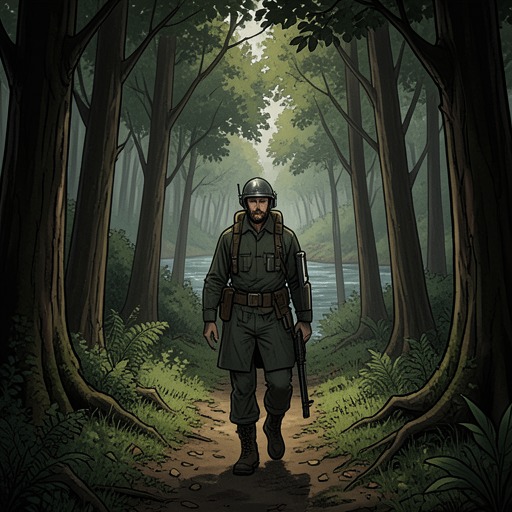
On the Congo River, darkness begins as a failure of familiar orientation. The waterway runs into overshadowed distances through wooded islands and deserted reaches; hippos and alligators lie on silvery sandbanks, while shoals repeatedly obscure the channel. Marlow describes losing his way as in a desert and feeling cut off from everything known in a former existence. Even sunshine brings no joy. The stillness is not peace but the presence of an implacable force, apparently brooding over an intention that remains unreadable.
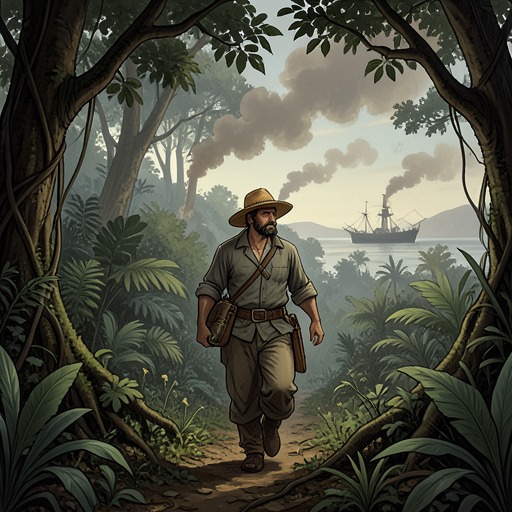
That pressure is sharpened by the work required to keep Marlow’s river steamboat moving. He must guess at the channel, look for hidden banks and sunken stones, avoid snags that might tear open the boat, and find dead wood for the next day’s steaming. The practical demands occupy his attention so completely that, as he puts it, “the reality—the reality, I tell you—fades.” Surface tasks both protect him from the wilderness’s implications and leave him aware of an inner truth he cannot bring fully into view. Darkness thus works through sustained uncertainty rather than through a single revelation.
The landscape also exceeds the language available to describe it. Marlow says that conveying the life-sensation of an epoch is impossible and that “We live, as we dream—alone.” The claim is not only that experience is difficult to communicate: the felt truth and meaning of a life resist complete transfer to another person. The narrative’s pauses and images of obscurity make that limit part of its form. Darkness names what remains beyond explanation even as Marlow attempts to tell his story.
Encounter and the unstable boundary of humanity
As the steamer travels deeper into the forest, faint drums carry along the river at night, and sudden glimpses of people on the shore break into the journey’s silence. Marlow initially frames the scene through estrangement: the earth seems unearthly, and the movement and cries appear incomprehensible to the passing Europeans. But his interpretation shifts when he admits that the people are not inhuman. The disturbing recognition is their humanity and his “remote kinship” with their uproar. What had seemed wholly alien may contain emotions and meanings—joy, fear, sorrow, devotion, valor, rage—that he cannot confidently distinguish or name.
This recognition does not dissolve the distance between the steamer and the shore. Marlow stresses that the travelers are too far away to understand what they witness, and that their own place in time separates them from the people they observe. Yet the encounter unsettles any easy division between civilized observers and an inhuman wilderness. Marlow argues that principles and outward acquisitions cannot guarantee moral steadiness when familiar protections fall away; a person needs an inward strength and deliberate belief. His own response remains practical as well as reflective: he does not go ashore, but attends to leaking steam pipes, steering, snags, and the African fireman below him. The scene holds recognition and distance, response and restraint, together without resolving them.
Darkness, Kurtz, and moral evasion
Before meeting Kurtz, Marlow knows him chiefly as a name associated with ivory and a remote station. At the Central Station, the ruined steamer, primeval mud, and silent forest frame his first sustained reflections on the man’s expected arrival. Marlow admits that he lets a would-be assistant manager imagine he has influence in Europe because he hopes the pretense might somehow help Kurtz. The admission complicates his stated hatred of lies: he says falsehood appalls him, yet he allows a false impression to stand for someone he has not even seen. Darkness therefore includes moral compromise within the supposed observer, not merely danger in the landscape or corruption in another man.
After Kurtz’s death, memory makes that compromise harder to leave behind. At the door of The Intended’s house, Marlow sees Kurtz on the stretcher as an insatiable shadow, and the vision carries the forest, the river, the crowd, and the drumbeat into the decorous city interior. The image makes the wilderness feel as though it has followed him home. He remembers Kurtz’s pleading and threats, his desires, and his claim that the ivory was his own and that he wanted justice. The repeated claim exposes the gulf between Kurtz’s appeal to justice and the possessive conduct Marlow recalls; the remembered “The horror! The horror!” reverberates alongside that contradiction.
The lie and the return of darkness
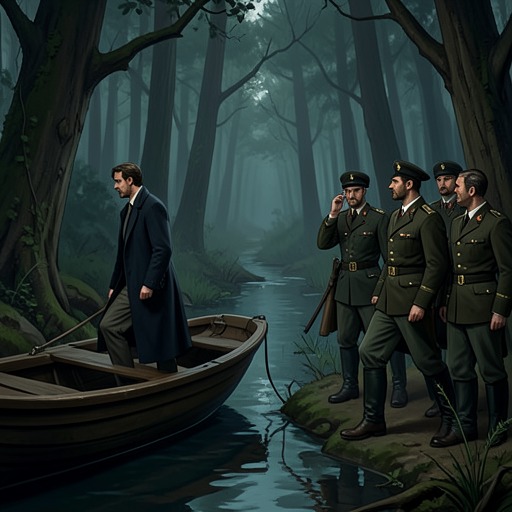
When The Intended asks for Kurtz’s last words, Marlow is caught between the words he remembers and the consoling belief she needs. She speaks of Kurtz as a man who drew out what was best in others and grieves for the loss to herself, to those around her, and to the world. Marlow recognizes her faith as an illusion that is also saving, but cannot defend her from the truth—or, as he acknowledges, himself. In the gathering dusk, her request for something to live with brings the remembered cry back to him as a whisper growing menacingly around them. He tells her instead, “The last word he pronounced was—your name.” She takes the answer as confirmation, and Marlow leaves without telling her what he remembers.
The withheld truth gives darkness an intimate and ethical form: Marlow’s silence preserves The Intended’s idealized memory of Kurtz while denying her the actual words he heard. The narrative does not present that choice as uncomplicated justice. Marlow wonders whether the heavens would have fallen had he told her the truth, then admits that he could not. After his account ends, the frame narrator sees a black bank of clouds across the offing and a waterway leading toward what seems to be “the heart of an immense darkness.” The image carries the motif beyond the African journey and beyond Kurtz’s death. Darkness remains in the present act of narration, where the desire to understand and the impulse to conceal meet, and where the story’s final destination is still uncertain.